
Stickwerk
StickwerkDie »Stickwerke« von Ute Essig Eigen ist allen Werkgruppen, dass man das Material und die Arbeitstechnik genuin als weiblich definiert. Und damit sind wir inmitten des Anliegens der Künstlerin, die die gesellschaftliche Konstruktion des Geschlechts in ihren...
2026 Mixed Double – Ute Essig + Henrik U. Müller
Mixed Double – Ute Essig + Henrik U. Müller 10.Oktober – 14. November 2026Eröffnung | Opening: Freitag, 9. Oktober, 19 – 21.30 Uhr Booklet Ute EssigBooklet Henrik U. Müller Artist Talk + Booklet LaunchSamstag, 14. November, 15 Uhr EinführungIntroduction...

2024 – It happened tomorrow
It happened tomorrow Ute Essig + Henrik U. Müller 15. März – 14. AprilEröffnung: Donnerstag, 14. April, 19 – 21.30 Uhr Artist Talk (in German): Samstag, 23. März, 15 Uhr (R.S.V.P.) Portfolio Text (deutsch)Text (englisch) CV Ute EssigCV Henrik U. Müller

2020 – bright to cloudy

2017 – Gedanken/Machen

2016 – 3 x Solo
Info
Ute Essig – Beyond Eden
Through her artwork, Ute Essig is well on her way to securing her place in the now dynamic history of art, using materials such as porcelain and ceramics as well as artistic techniques like embroidery and knitting.
A characteristic of these groups of works is that the materials and techniques used are generally defined as feminine. It can also be put this way: A characteristic of all these groups of works is that the materials and techniques are still defined as feminine. And this brings us to the heart of the artist’s concern, as she also challenges the social construction of gender in its sociocultural and political manifestations—or at the very least, holds up a mirror to it: “Traditional” craft techniques such as embroidery and knitting are deliberately adapted as artistic techniques, employed in subtle and unorthodox ways, and developed in a way that is both idiosyncratic and, to us, surprisingly “fresh” within Ute Essig’s visual and formal language.
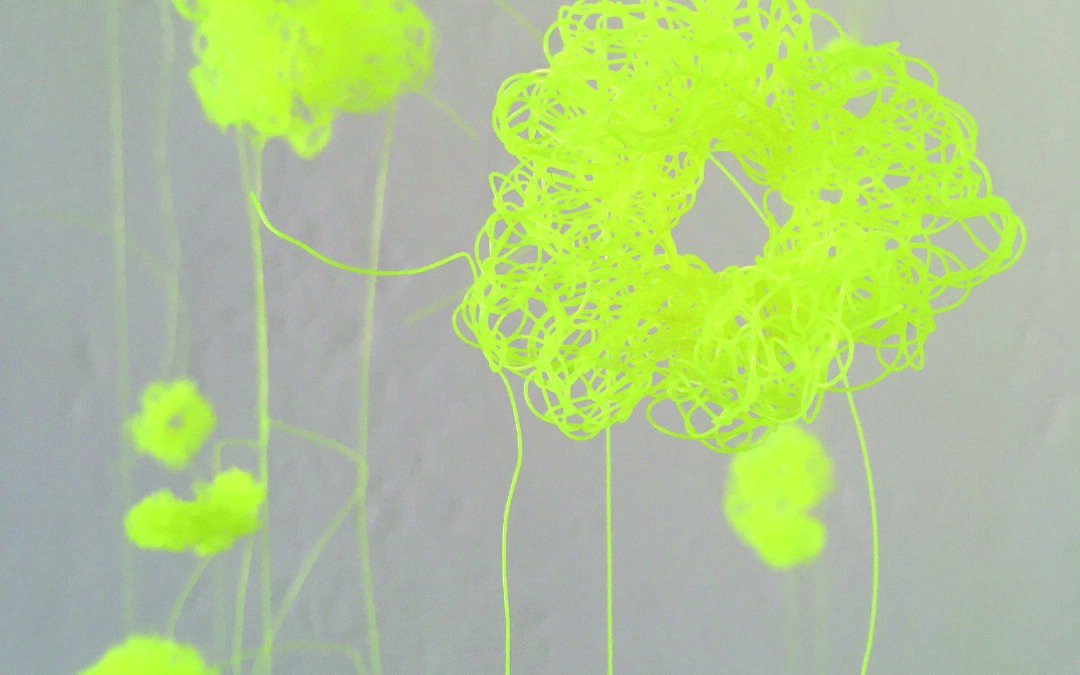
In Ute Essig’s work, the starting and ending threads—which are usually hidden—take on a visible, artistic function, making the embroidery appear like a three-dimensional drawing on paper.
The amplification of individual porcelain forms through serial repetition in site-specific installations as a striking statement, the embroidery of pithy slogans from the graffiti scenes in Berlin and London onto Japanese paper, and the firing of socially critical messages—in text and image—onto her sculptural vases all reveal the artist as a free spirit who draws inspiration from society and life.